
Where Is God When Everything Falls Apart?

By Pastor Ben Reichel, Youth & Young Adult Pastor at St. Mark Ministries
What bothers you? Not what irritates you or frustrates you in the moment, but what bothers you deep down? And what are you going to do about it?
Here’s another way to think about it: What bothers you when God seems silent? What bothers you when God says He’s in control, but your life feels anything but? What bothers you when prayers seem to go unanswered, when life seems out of control, when relationships fracture, when diagnoses show up unexpectedly and uninvited, and pain and suffering appear unexplained?
The book of Job doesn’t rush to make us feel better about those questions. It does not offer easy answers, quick fixes, or clean formulas. Instead, it gives us something better. It gives us a big God who invites us to trust that He really is in control even when we can’t see what He’s doing or what He’s planning.
But in order to see that invitation, we need to sit where Job sat. Join me in a retelling of Job’s story.
The Account of Job’s Suffering
“I used to think that I knew how my life was supposed to go. I feared God. I avoided evil. I did everything I was supposed to do. I worked hard, loved my family, prayed for my kids. I thanked God for all of His blessings. Then one day, without warning, everything collapsed.
Messenger after messenger, loss piled on loss. I didn’t even have time to wrap my mind around the first disaster when the next one was already on its way – my livelihood, my flocks, my servants, my children. I tore my robe, shaved my head, fell down on the ground, and I worshiped. But worship doesn’t cancel grief. Faith doesn’t numb pain.
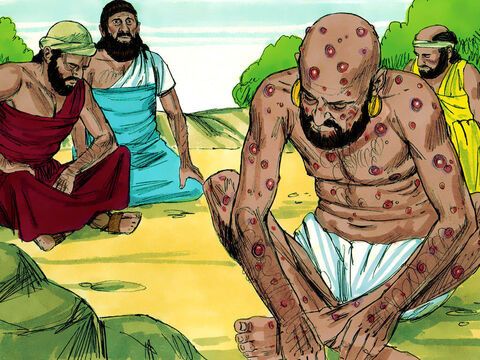
Because then my body failed me, too. Painful sores from head to toe. No reasoning, no explanation, no relief. I sat down in literal ashes because I had nowhere else to sit. I scraped my body because the pain on the outside finally matched the pain on the inside. But you know something? I didn’t know what was going on behind the scenes.
I didn’t know what God was planning. I didn’t know the limits that God had already set in place. I didn’t know the protection He already had around me. I didn’t know what Satan was scheming. I didn’t know how everything was going to end. I didn’t know that even though everything felt out of control, nothing really was. I only knew pain.
I only knew suffering.
Maybe you know that pain too? Because when suffering and pain settle in like that, it does something to us.
And then my friends showed up, and they did something holy. They sat with me. They wept with me. They didn’t say a word for seven days and seven nights. That was the most faithful thing they could have done.
But then they just had to go and open their mouths. They started explaining, analyzing, diagnosing. They said that my suffering was a punishment. They said that God blesses the faithful and disciplines the sinful. So which one do you think they thought I was? They said that if I just admitted my guilt, everything would make sense again.
I slowly, painfully started listening to them. I replayed my life, my prayers, my failures, everything. And when I couldn’t find an answer, something even more painful and more wicked happened. I stopped asking the question, ‘What did I do wrong?’ I started asking, ‘What did God do wrong?’
Now, I didn’t stop believing in God. I didn’t stop talking to Him. But I stopped trusting that He knew what He was doing. I wanted answers. I wanted explanations. I wanted control.
Maybe you’ve been there too. Because suffering doesn’t make us faithless, but it sure makes us a whole lot messier. Pain doesn’t disqualify faith, but pretending like we understand God does.”
God Responds to Job
And that is where Job finally crosses a line – not because he was questioning God, but because he put himself in a position to think that he could judge God.
That is when God speaks. Not gently, not quietly, but from a whirlwind. God doesn’t explain Job’s suffering. He doesn’t justify himself. God doesn’t answer that all-too-common question of “why.”
This time around, God’s the one asking the questions: “Where were you when I laid the earth’s foundation? Have you ever commanded the morning? Do you know the laws of the heavens?”
When you have time, I want you to read all of Job chapters 38, 39, 40, and 41 to read all the questions that God fires back at Job. Four chapters worth of questions!
And chances are you’re going to read those questions and say, “Man, God’s being pretty cruel.” He’s not. He’s correcting. God doesn’t dismiss Job’s suffering. He doesn’t try to explain it away. He actually fully acknowledges it. But what God does with these questions is remind Job who God is and who isn’t God.
He has to set boundaries before He gives comfort. Because when we think we understand God, we stop trusting Him. When we stop trusting God, then we start to think we are in control. God doesn’t shrink to fit Job’s tiny expectations. What He does is expand Job’s vision.
Job Repents and is Restored
Next, something remarkable happens. Not outside of Job, but inside. Let’s keep reading the story from Job’s perspective.
“I had heard of God. I had learned of Him. I had talked about Him. But now I had seen God. And suddenly my questions seemed a whole lot smaller than God’s greatness. I didn’t receive an explanation. I received God. And then I had to say, ‘Surely I spoke of things I did not understand.’ And for the first time when I confessed that, it didn’t crush me – it freed me.”
What you read in chapter 42 is that once Job admitted that truth, God restored him. He healed him and showered blessing after blessing on Job!
But at this point, we need to be cautious. We need to be careful because while Job’s restoration in that final chapter is real, that doesn’t mean that you and I can expect everything to be fixed in this life.
God does promise to restore everything. You will get everything back and more – it just might not be here. Maybe you and I have to wait until heaven before we see everything fixed. But the deeper promise of Job is not doubled possessions. It’s restored trust. And you can see that Job always had that trust.
Even while he was doubting, long before God restored his fortunes, Job had already spoken a greater hope: “I know that my Redeemer lives” (Job 19:25 (NIV). Smack in the middle of his whining and complaining, Job still has that hope!
And that Redeemer is Jesus. The same God who spoke from that whirlwind stepped into suffering Himself. The almighty Creator put on fragile, frail human flesh.
That God who questioned Job allowed Himself to be questioned and mocked and crucified. And when Jesus entered into that suffering, He didn’t explain it. He didn’t explain it away. He bore it. He endured it. Then He redeemed it. On that third day when He walked out of the grave, Jesus was proclaiming that suffering will not have the last word for any of us.
Trusting in God’s Eternal Promises and Wisdom
This is why our trust doesn’t rest on outcomes. It rests on the living Redeemer. You are not home yet, but you’re not abandoned either.
So, I’m going to ask that question one more time: What bothers you? What bothers you when it feels like God is silent? What bothers you when life feels chaotic? What bothers you when you can’t see His plan? What if God being in control isn’t something we were meant to see right now, but something we were meant to trust?
Even when God is silent, even when it seems like our life is out of control, even when you can’t see Him, even when you can’t hear Him, even when the storm hasn’t even passed yet, God is good. God is sovereign, and God is in control.
And because your Redeemer lives, He will take care of you.
Amen.